

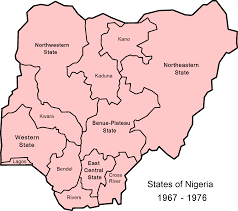
On May 27, 1967, Nigeria took a bold step that would forever redefine its political and administrative framework. That day, General Yakubu Gowon, then Nigeria’s military Head of State, announced the creation of 12 states, replacing the former four regional structures—Northern, Western, Mid-Western, and Eastern Regions.
This landmark restructuring wasn’t just a bureaucratic reorganization—it was a pivotal response to the country’s deepening national crisis, an attempt to quell ethnic tensions, and a strategic move to prevent national disintegration.
The Nigeria of Pre-1967: Regions and Rivalries
Before 1967, Nigeria was governed through four powerful regions:
- Northern Region
- Western Region
- Eastern Region
- Mid-Western Region (carved out in 1963)
These regions enjoyed a significant degree of autonomy and were dominated by the three largest ethnic groups: the Hausa-Fulani in the North, the Yoruba in the West, and the Igbo in the East. The result was growing ethnic nationalism, regional competition, and political instability.
The first military coup of January 1966, followed by a counter-coup in July 1966, brought the country to the brink of civil war. The killing of Easterners (mostly Igbos) in the North and escalating demands for secession by the Eastern Region—led by Lt. Colonel Chukwuemeka Odumegwu Ojukwu—further strained national unity.
The Creation of 12 States: Gowon’s Federal Gamble
On May 27, 1967, in a national broadcast, General Gowon announced a major political shift: Nigeria would be restructured into 12 states. The decision was not made through national consensus or parliamentary debate—it was a unilateral military order aimed at disarming the rising momentum of secession and redistributing political power.
The newly created states were:
- North-Western State (capital: Sokoto)
- North-Eastern State (capital: Maiduguri)
- Kano State (capital: Kano)
- North-Central State (capital: Kaduna)
- Benue-Plateau State (capital: Jos)
- Kwara State (capital: Ilorin)
- Western State (capital: Ibadan)
- Lagos State (capital: Lagos)
- Mid-Western State (capital: Benin City) – retained its 1963 creation
- East-Central State (capital: Enugu)
- Rivers State (capital: Port Harcourt)
- South-Eastern State (capital: Calabar)
Read Also: When Nigeria Stood Still: Remembering the 2013 State of Emergency Declaration
Strategic Motivations Behind the State Creation
General Gowon’s objective was clear: weaken the power of the regions, especially the Eastern Region under Ojukwu, and give minority ethnic groups a voice in governance. For example:
- Rivers and South-Eastern States were carved from the Eastern Region to empower ethnic minorities like the Ijaw, Ibibio, and Efik—many of whom felt marginalized under Igbo leadership.
- Northern Region, a behemoth in both landmass and population, was broken into six states to prevent any single power base from dominating the federation.
This restructuring was also meant to ensure direct federal control over resources like oil in the Niger Delta and solidify central authority ahead of any possible secession.
The Aftermath: Civil War and Federal Evolution
Despite Gowon’s intentions, the state creation did not stop the secession of the Eastern Region. On May 30, 1967, just three days later, Ojukwu declared the Republic of Biafra, triggering the Nigerian Civil War (1967–1970), one of Africa’s bloodiest conflicts.
However, the new state structure would outlast the war. It became the foundation of Nigeria’s modern federalism, providing a model for the creation of more states over time—rising from 12 to 19 in 1976, and eventually to the 36 states of today.
Read Also: Remembering Obafemi Awolowo: The Visionary Who Shaped Nigeria’s Political Foundation
Legacy of May 27, 1967
Today, the state creation of May 27, 1967, remains one of the most influential events in Nigerian history. It marked:
- The end of regional domination
- A symbol of federal restructuring
- The beginning of power redistribution to ethnic minorities
- The blueprint for future administrative changes
It is a day that reshaped Nigeria’s identity, governance, and internal politics. Even as debates around restructuring and resource control continue, the legacy of that day remains undeniable.
