

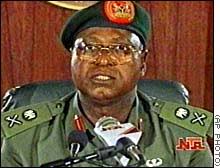
On Tuesday, June 9, 1998, Major-General Abdulsalami Abubakar was sworn in as Nigeria’s 11th Head of State, marking a significant and hopeful chapter in the nation’s history. Abubakar’s sudden rise to power followed the unexpected death of General Sani Abacha, who had ruled Nigeria with an iron grip since 1993.
As the military government’s new leader, Major-General Abdulsalami Abubakar faced a complex web of challenges: a country yearning for democracy, political prisoners locked away, and a battered international reputation. The world watched closely as Nigeria stood at a crossroads.
Read Also: The Enigmatic Demise of Nigeria’s Strongman: A Look Back at General Sani Abacha’s Mysterious Death
The new head of state’s emergence brought cautious optimism. The Clinton administration in the United States, reflecting the sentiments of much of the international community, extended an olive branch. They signaled a willingness to forge closer ties with Nigeria—if Abubakar’s military government would take bold steps toward democratic reforms and release political prisoners.
Read Also: Nigeria’s Twitter Ban of 2021: A Deep Dive into the Government’s Crackdown on Social Media
Abubakar’s leadership was tested immediately. His approach offered a stark contrast to his predecessor’s regime: instead of clamping down on dissent, Abubakar expressed his commitment to setting Nigeria on a path to civilian rule and democratic governance. In his early speeches, he emphasized the importance of reconciliation, political stability, and national unity.
The significance of this moment in Nigeria’s history cannot be overstated. It marked the start of a transition period that ultimately led to the birth of the Fourth Republic in 1999, with the election of President Olusegun Obasanjo. Abubakar’s brief but pivotal rule was instrumental in guiding the nation away from the shadows of military dictatorship and towards democratic restoration.
Read Also: The Assassination of Kudirat Abiola: A Pivotal Moment in Nigeria’s Democracy Struggle
More than two decades later, June 9, 1998 remains a powerful reminder of the resilience of the Nigerian spirit and the enduring hope for a better future.
