

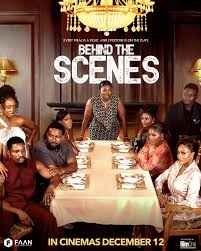
Funke Akindele has built an entire cinematic universe around moral lessons, family dynamics and exaggerated reflections of everyday Nigerian life. With Behind the Scenes, co-directed by Tunde Olaoye, that universe expands once again. The film introduces Ronke Fernandez, a wealthy and benevolent woman whose generosity becomes a curse as her family and friends drain her emotionally and financially. It is a story many Nigerians instantly recognize. For better or worse, familiarity is both the film’s greatest strength and its most limiting weakness.
As the undisputed queen of the Nigerian box office, Akindele enters every release with enormous commercial expectations. Critically, however, the bar remains far lower. Behind the Scenes fits neatly into that pattern. It is an original story not tied to any of her previous franchises, yet it carries the same creative habits that have defined her recent work.
Read Also: NWFL Week Four Review: Robo Queens Ruthless As Lagos Derby Explodes With Goals
At its core, the film wants to explore the burden of being the family backbone. In Nigerian homes, there is often one person expected to solve every problem, pay every bill and rescue every emergency. For some viewers, this story will feel deeply personal. Unfortunately, the emotional truth of that reality is buried beneath layers of artifice that never allow the film to truly breathe.
The characters exist largely on the surface. The story announces its twist far too early, leans heavily on tired stereotypes and struggles with intrusive product placement that pulls attention away from already fragile emotional beats. Even moments designed to land with weight are stretched with melodramatic music and overemphasized performances, asking for tears without earning them.
Read Also: Golden Generation on Display as Team Nigeria Dominate African Youth Games Podiums
A recurring issue in Nollywood appears again here. Performance and presentation rarely align. Characters are styled to perfection even in moments that demand vulnerability. In a late-night scene where Ronke plays chess with Mariam, portrayed by Uche Montana, both women are visibly layered with heavy makeup in what should be a relaxed and intimate setting. This visual dissonance persists throughout the film, reinforcing the sense that the characters never truly inhabit their world.
Still, sparks of promise occasionally break through. Scarlet Gomez delivers a solid performance as Ronke Fernandez, managing to inject some life into a character written as almost impossibly perfect. Her presence provides contrast against the greed and entitlement that surround her. Tobi Bakre brings energy as Adewale, the entitled last born whose arrogance initially feels believable, even if his later transformation lacks depth.
Read Also: Fabunmi and Ojo Power Nigeria to Table Tennis Glory at African Youth Games
Funke Akindele herself takes time to settle into her role as Adetutu. Early scenes flirt dangerously close to the familiar Jenifa persona before she eventually finds balance. Unfortunately, that balance does not extend to the film’s broader narrative.
The moral spoon-feeding that has become a trademark of Akindele’s projects returns in full force. Values are explained rather than explored. Dialogue pushes information directly at the audience instead of revealing character relationships organically. At one point, Uzor Arukwe’s character Victor explains Ronke’s diagnosis with all the subtlety of an instructional prompt, undermining what should be a deeply emotional turning point.
Humour often comes at the cost of nuance. Jokes built around tribal marks and exaggerated accents feel dated and lazy, echoing problems seen in earlier Nollywood projects. Destiny Etiko’s role as the maid Oluchi occasionally taps into genuine emotion, but the inconsistent accent and caricatured portrayal are clearly designed for cheap laughs rather than character authenticity.
Read Also: Awaziem Scores, Akinsanmiro Debuts as Super Eagles Fall Narrowly to Egypt
Narratively, the film struggles to hold itself together under scrutiny. Ronke is briefly presented as a meticulous planner only to unravel abruptly without proper buildup. Adewale’s character arc is rushed, and Victor’s role as a lawyer nearing senior advocate status exists solely to deliver plot points rather than contribute meaningfully to the story.
Visually, Behind the Scenes offers little excitement. The cinematography is functional but uninspired, relying on templated shots that neither elevate nor interrogate the narrative. The sets are glossy to the point of distraction. These characters feel like visitors in their own homes. Wealth is mentioned frequently through dialogue, but the portrayal is generic and hollow, stripping money of any real narrative weight.
In the end, Behind the Scenes never truly goes behind any scenes. It continues Funke Akindele’s didactic storytelling tradition inherited from Yoruba theatre without refining it for cinematic depth. What could have been a sharp examination of financial pressure within families becomes a familiar moral lecture weighed down by stereotypes, forced humour and intrusive advertising.
Read Also: NWFL Week Four Lights Up Nigeria As Super Six Dreams and Survival Hopes Go Head-to-Head
Still, Akindele understands her audience. The film delivers enough laughter, confrontation and spectacle to satisfy the December crowd. A wedding finale seals its commercial appeal. Its position as one of the highest-grossing films of the year feels inevitable.
The lingering question is whether this creative safety net is quietly limiting not only Akindele’s growth as a filmmaker but also the broader ambitions of Nollywood itself.
Behind the Scenes was released nationwide in cinemas on December 12, 2025, and it has already grossed over two hundred million naira in the opening weekend.
